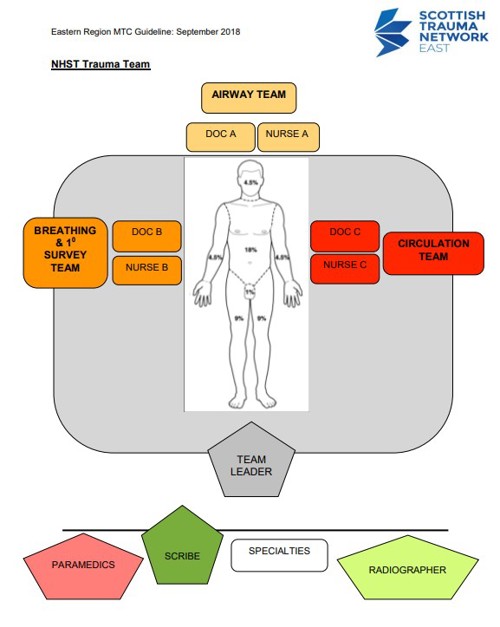
Roles and responsibilities of the trauma team

General NHST trauma team rules

The NHST Trauma Team adopts a horizontal management approach to trauma with team members acting simultaneously to stabilise the patient’s airway, breathing and circulation in predefined roles, under the direction of a team leader. 

Simple rules are required to help this system work:

  1. If you are a designated trauma team member, and the trauma page is activated please attend the ED resuscitation room immediately.
  2. On arrival introduce yourself to the team leader.
  3. Do not enter the area around the patient unless invited by the team leader.
  4. Feed information/findings to the team leader.
  5. All requests for nursing assistance/resources are via the team leader.
  6. Follow your role as described in this document.
  7. Keep unnecessary conversation to a minimum.
  8. If you have any thoughts/information/suggestions address them to the team leader.
  9. Only leave when you have been given permission to do so by the team leader.

The Trauma Team has 4 common goals to be performed as rapidly as possible:

  • Identify and treat life threatening injuries.
  • Identify any other problems.
  • Arrange appropriate treatment and investigations.
  • Arrange and transfer to definitive care.

NHST trauma team configuration

Role Personnel Core responsibilities
Team leader

ED consultant

(EDST4+ until ED consultant arrives)*

Team leader
A-team

Doc AAnaesthetic/

ICU consultant or SR

Airway, GCS, pupils, analgesia
  Nurse – Anaesthetic nurse/ ODP** /ED nurse Airway assistant, prepare drugs and equipment for transfer
B-team Doc – ED middle grade /surgical middle grade /orthopaedic middle grade Breathing assessment, chest interventions, primary survey
  Nurse BED nurse Prearrival checklist, apply monitoring, initial obs, assist with chest interventions
C-Team Doc CED middle grade / Surgical middle grade /  orthopaedic middle grade

Control external haemorrhage, large bore IV access, bloods inc G&S/

X-match(hand sample to BMS if code red)

  Nurse CED nurse Pre-arrival checklist, clothing removal, preparation of Belmont blood warmer, administer fluid/ blood products
Other Scribe Record personnel, prepare trauma documentation, record observations

Between 01:00 and 08:00 Monday Friday and on occasion between 22:00 and 08:00 at weekend.

** ODP/Anaesthetic nurse must have completed ED familiarisation training package.

Resus room team positioning

Trauma team leader checklist

Pre-arrival:

  • Trauma team activated
  • Team members book in’ with scribe / team leader
  • Protective equipment worn by all key personnel
  • Ferno Germa vacuum mattress prepared on resus trolley
  • Introductions done and team roles assigned with clearly named badges
  • Nursing pre-arrival checklist done, equipment ready
  • CT aware and ready (and occasionally blood bank, theatres)
  • Consider-anaesthetic drugs drawn up / Belmont blood warmer primed
  • Consider- code red activated? activates MHP (see appendix 1) and mandates escalation to specialty consultants
  • Paediatric calculations if indicated
  • ATMIST on the board (Age,Time of Injury, Mechanism, Injuries, Vital Signs,Treatments)

On patient arrival:

  • Start the clock (delegate to nurse A)
  • All listen for concise 30 second handover from paramedics before transferring patient to trolley unless critically ill.
  • Ensure one paramedic immediately attends reception to register patient.
  • Command resuscitation, prioritising investigations  and treatments of blunt trauma and signs of haemodynamic instability, consider pelvic binder.
  • Consider massive transfusion activation if ongoing significant bleeding suspected (2222–request massive haemorrhage ED resus then contact blood bank ext 33394 to give patient details – see appendix 2)
  • Give tranexamic acid if ongoing bleeding suspected (1g over 10 mins, then 1 gas infusion over 8hours. Paeds-15mg/kg bolus, then 2mg/kg/hr
  • If meets WBCT criteria (Adult–see appendix 3, Paed–see appendix 4) alert CT radiographer (Ext 35071), give estimated time to CT. Aim for CT within 30minutes. Co-ordinate quick, but safe transfer and ongoing resuscitation in scan. Consider CT in lieu of primary survey x-rays in selected cases.
  • Speak to relatives
  • Ensure Major Trauma documentation completed.

Scottish Ambulance Service (SAS) - paramedics

  • If patient has been involved in a high mechanism incident or appears to have significant injury, the Major Trauma Triage Tool (MTTT) should be applied (see appendix 5)
  • If Major Trauma “positive”, place a pre-alert via airwave or ask ACC to place pre-alert.

On arrival:

It is always preferable for patients to arrive after a pre-alert with secured iv access in place and fully undressed, on a scoop stretcher with temperature control measures instituted.

  • On arrival in Emergency Department resuscitation bay 1, move to the left side of the trolley as approaching the foot of the bed.
  • Unless patient critically unstable, stop all movements and give a clear, concise 30 second handover to the Team Leader / Trauma Team then transfer patient to ED trolley on scoop stretcher.
  • Remove scoop with assistance from the Trauma Team under guidance of Trauma Team Leader.
  • Further detail of the history can then be passed directly to the Team Leader whilst assessment of the patient starts in ED.

One paramedic should give patient identity details to the receptionist ASAP after arrival for patient registration. The other team member should ensure scribe has all handover details and update ATMIST whiteboard if relevant. They should also ensure that the Trauma Team Leader has all information required before leaving the department.

Handover should include the ATMIST content:

A Age

T Time of injury

M Mechanism

I Injuries

S Vital signs

T Treatments commenced

Airway Team –anaesthetist and nurse A/ODP

  • Ensure patient oxygenated and ventilated with no airway obstruction.
  • Intubate when appropriate in discussion with the Trauma Team Leader.

Pre-arrival:

  • Check in with Team Leader / Scribe 
  • Put on personal protective equipment and designation sticker with first name visible
  • Ensure all airway equipment ready and available, check ventilator
  • Draw up intubation drugs if indicated

Arrival:

  • Unless acute airway compromise, listen to concise 30 second handover from paramedic team before assisting with transfer to resus trolley
  • Communicate airway patency and issues to Team Leader / Scribe
  • Assess respiratory rate and inform Team Leader / Scribe
  • Ensure cervical spine immobilisation, anaesthetist will usually control log roll if indicated
  • Reassure patient on arrival, set the scene of what is happening. Provide and communicate on-going assessment of GCS. Provide adequate analgesia.
  • Obtain AMPLE history:

A Allergies

M Medications

P Past medical history

L Last meal

E Everything else relevant

Inform outcome to Trauma Team Leader / Scribe.

  • Consider the need for a endogastric tube
  • Arterial lines may be indicated, but consider whether this can be done after CT or in the operating theatre
  • Communication with theatres –role is shared with surgeon
  • Anaesthetist may have role of lead for massive transfusion protocol in ED, once in theatre this is almost certain and blood bank must be informed of any patient movements
  • Anaesthetist/Nurse 1 lead transfer of patient to CT/theatre
  • ED leader to complete “ready to go” checklist prior to patient transfer(see appendix 6)

Breathing and 1st survey team (doctor B and nurse B)

Doctor B:

  • ED middle grade / surgical middle grade/ orthopaedic middle grade
  • Undertakes the primary survey (excluding airway) according to ATLS principles

Pre-arrival:

  • Login with trauma team leader and scribe
  • Put on personal protective equipment and designation sticker with first name visible
  • Check equipment ready – chest drains pelvic splints 

Arrival:

  • Listen to 30 second paramedic handover then assist with transfer to resus trolley
  • Help remove chest clothing and immediately assess chest, neck and effectiveness of ventilation undertake any necessary “breathing” interventions
  • Utilise chest drain pre-insertion checklist if indicated (see appendix7)
  • Communicate findings clearly to trauma team leader and scribe
  • Continue with primary survey, including abdomen, pelvis and long bones

Take AMPLE history if anaesthetist busy, reassure the patient on arrival, set the scene of what is happening:

A Allergies

M Medications

P Past medical history

L Last meal

E Everything else relevant

Perform procedures depending on skill level and training:

  • Undertake secondary survey at earliest opportunity, documenting findings clearly on proforma. NB rapid neurology exam needed before paralysing anaesthetic agents used.
  • May activate massive transfusion protocol after discussion with trauma team leader.
  • Administer drugs e.g analgesia, antibiotics.
  • Ensure patient kept warm.

Nurse B:

Pre-arrival:
  • Prepare for trauma call using pre-arrival checklist (see appendix8).
  • Put on personal protective equipment and designation sticker with first name visible.
Arrival:
  • Listen to 30 second paramedic handover then assist with transfer to resus trolley.
  • Have tuffcut scissors ready, remove enougclothing initially to attach monitoring.
  • Nurse C will continue to remove clothes while first set of observations are obtained as priority.
Clearly state first observations to trauma team leader and scribe as soon as available.
  • Assist doctor with procedures as necessary e.g chest drain, pelvic binder.
  • Draw up drugs administer IV infusions as prescribed.
  • Prepare for transfer to CT ASAP (possibly within 10-20 minutes) and /or theatre. 
Transfer preparation will include:
  • Preparation of monitoring equipment Phillips X2 transfer monitor. 
  • Full oxygen cylinder with Schraeder valve.
  • Ventilator, propofol infusion and capnography if intubated.
  • Drugs (as directed by anaesthetist).
  • Transfer bag.
  • Fluid / blood as directed.
  • Complete “Ready to go” checklist prior to transfer.

Circulation team – (doctor C and nurse C)

Doctor C: 

  • ED middle grade / surgical middle grade / orthopaedic middle grade

Pre-arrival:

  • Login with trauma team leader and scribe.
  • Put on personal protective equipment and designation sticker with first name visible.
  • Wear personal protective equipment including lead.
  • Ready access and blood-taking equipment.
  • Familiarise with Typenex system.

Arrival:

  • Listen to 30 second paramedic handover and assist with transfer of patient to resus trolley.
  • Assist in stemming active external haemorrhage with direct compression.
  • As soon as possible obtain two large bore peripheral lines takin 20mls of blood at same time.
  • Use designated trauma set” on ICE and complete handwritten blood transfusion form to go with BTS sample.
  • Ensure bloods are sent – porter may be available as runner.
  • Order x-rays and CT on ICE in discussion with trauma team leader (trauma order sets).
  • Obtain arterial blood gas.
  • Assess abdomen, pelvis, long bones if doctor is unable to complete primary survey.
  • Perform assist with procedures depending on skill level and training and as guided by trauma team leader.
  • Ensure patient kept warm.

Nurse C:

Pre-arrival:

  • Prepare for trauma call with nurse B using pre-arrival checklist.

Arrival:

  • Listen to 30 second paramedic handover prior to patient transfer to Resus trolley.
  • Have scissors ready – remove all clothing including underwear and store securely.
  • Assist in stemming external haemorrhage with direct pressure.
  • Cover patient with blankets / Bair hugger.
  • Help with getting IV access and sending bloods off. If required, set up intra-osseus kit (EZ-IO).
  • Give IV fluids / blood as directed, manage Belmont blood warmer.
  • Help with procedures as necessary e.g catheter, chest drain, pelvic / Thomas splints, arterial line.
  • Dressings and splints, photographs of open fractures / significant wounds.
  • Ensure patient kept warm.

Scribe

This is a complex but vital role. Ensure you are being given the information you require and inform the trauma team leader if you are not.

  • Fill out the trauma documentation.
  • Ensure the clock is started by Nurse A / ODP when patient arrives in Resus Bay 1.
  • Document team members and arrival times including specialty and grade.
  • Document vital signs every 5 minutes in unstable patients and every 15 minutes otherwise.
  • Maintain a chronological record of all events eg time of venflon, CXR, move to CT etc.
  • Ensure patient wrist labels are secured on patient.
  • Inform Trauma Team Leader if key observations have not been identified eg temperature, BM, GCS.
  • Inform the Trauma Team Leader every 15 minutes that pass, the aim is to be in CT within 20-30 minutes when appropriate.
  • Keep a log of the running total of blood products transfused in a massive haemorrhage situation this role may be done by Nurse C.
  • Prompt the trauma team leader when 4 units of blood have been transfused.


Senior nurse

  • Nurse in charge should attend initially and coordinate staff and resources. They may be in a position to initiate the trauma call if deemed necessary.
  • Inform ED consultant of trauma call and give pre-hospital information.
  • Provide support for the team and knowledge of the department.
  • Coordinate with Trauma Team Leader early regarding the transfer of patient from ED.

Radiographer

  • Ascertain ETA of patient and prepare mobile unit.
  • Lead aprons to be worn if team unable to leave side of patient.
  • Liaise with trauma team leader if team members are obstructing your chance to x-ray to prioritise actions.
  • Liaise with trauma team leader if electronic x-ray request is delaying imaging.

CT radiographer / radiologist

  • In Hours CT Radiographer will receive Trauma call pre-alert via switchboard (ext 35071).
  • Out of hours –on-call radiology SpR will receive trauma call pre-alert via switchboard, “code red” pre-alert will be escalated to on-call interventional radiologist.
  • Trauma Team Leader should indicate to CT radiographer ETA as early as possible.
  • CT radiographer prepares to clear scanner and should seek ETA of patient from Resus (ext 32170) if not informed by trauma team.
  • CT radiographer to inform trauma team leader if different CT scanner to be utilised.
  • Trauma team and radiologist to discuss findings ASAP in order to inform definitive care.

ED reception staff

  • Reception staff should be alerted that Trauma call initiated and prepare to prioritise logging patient on TRAKCARE in order to facilitate investigations etc.
  • Liaise early with SAS paramedic in order to obtain patient details.
  • Direct relatives of trauma patient(s) to relatives room and inform them that a member of medical or nursing staff will be with them shortly.

Notes for general surgical middle grade doctor

  • May fulfill role of Doctor B or C
  • Inform general surgical consultant on-call if patient has initial SBP below 90 with potential abdominal trauma, has complex multisystem injury or is likely to need early surgery.
  • “Code Red” patients or patients who trigger massive transfusion protocol must be escalated to general surgical consultant.
  • Stay with the patient in resus/CT until stood down by the trauma team leader.
  • Perform abdominal examination during secondary survey. Clearly inform trauma team leader and scribe of findings.
  • Discuss surgical plan / needs / priorities with trauma team leader.
  • Liaise with theatres, anaesthetic colleagues, bed manager and consultant for patients needing theatre and / or admission.
  • Document all actions and findings with a clear plan in major trauma admission book.

Notes for orthopaedic middle grade doctor

  • May fulfill role of Doctor B or C.
  • Inform T & O Consultant on call if patient likely to need early surgery or has complex orthopaedic injuries.
  • Perform secondary survey of limbs and clearly inform Trauma Team Leader and Scribe of findings:
    • Document all wounds, grazes and degloving.
    • Evaluate each joint and long-bone for dislocation / stability / fracture.
    • Neurovascular examination of all limbs.
    • Record presence or absence of key peripheral pulses and neurological findings.
    • Identify peripheral injuries that need further imaging.
    • Splint fractures.
    • Repeat neurovascular examination after splinting.
    • Arrange appropriate x-rays.
    • Peripheral x-rays must not delay trauma CT scan.
    • In some cases it may be best to delay x-rays until patient is in theatre and good quality traction x-rays can be obtained.
    • If Pelvic binder has been applied, do not remove without trauma team leader / orthopaedic consultant’s consent.
  • Discuss T & O plan / needs / priorities with trauma team leader.
  • Stay with the patient in resus / CT until stood down by trauma team leader.
  • Liaise with theatres, anaesthetic colleagues, bed manager and consultant for patients needing theatre and / or admission.
  • Document all actions and findings with a clear plan in major trauma admission book.

Reception of paediatric major trauma

  • In the event of a standby for a paediatric major trauma (Age below 16) a paediatric major trauma call should be made to switchboard.
  • Resus Bay 1 should be used to receive the patient unless an adult is also expected.
  • The initial Trauma Team members should initially be called as per standard adult Major Trauma which includes:
    • Anaesthetic SR and/or consultant
    • Orthopaedic MG
    • General surgical MG
    • BTS BMS
    • Theatre charge nurse / co-ordinator
    • CT radiographer
    • CT radiologist

Switchboard should make an additional call to:

  • Duty paediatrician (4184)to attend ED (paediatric consultant should be informed and decision on who is best placed to attend). 

Note: the first on duty anaesthetic SR can liaise with the on-call paediatric anaesthetist. If a paediatric code red” has been declared pre-hospital then the paediatric anaesthetist should be asked to attend the resuscitation room.

Preparation of equipment:

  • The paediatric airway trolley should be moved to resus bay 1
  • Appropriate age based resuscitation sheet selected and appropriate drugs and fluids prepared.

Roles of the paediatrician:

  • The paediatrician should report to the trauma team leader on arrival
  • Depending on the formation and skill sets of the trauma team, the paediatrician should be utilised at the discretion of the trauma team leader
  • The majority of paediatricians are APLS qualified and can be part of the team as Doctor B or C, this may be most likely if there is more than one paediatric trauma patient
  • It is likely that the vital role of the paediatrician will be to co-ordinate onward care such as with paediatric HDU and with Scotstar PICU Retrieval, as well as assisting in liaising with the child’s family who may be present in the resuscitation room.

Editorial Information

Last reviewed: 30/09/2018

Author(s): Dr Mike Donald, Dr Barry McGuire, Mr Gavin Love, Dr Katie Hands, East of Scotland Blood Transfusion Centre, Mr Allan Low, Dr Ian Zealley, Mr Chris Payne, Mr Kenneth Freeburn, Mr William Lambie, Dr Linda Clerihew, Dr Grant Rodney, Dr Michael Johnston, Dr Brodie Paterson, Dr Colin Donald, Dr Ron Cook, Dr Ian Zealley, Dr Sanjay Pillai, Dr Sarah Maclean, Dr Jonny Seeley, Dr Ian Kennedy, Dr Karyn Black, Miss Sarah Gill, Dr Colin Murray, Ms Clare Bryson, Ms Katrina Duncan, Mr Ross Cairnie, Ms Lynn Lyburn, Ms Susan Henderson, Ms Jill Beattie, Ms Katie Ferguson..