

Eating disorder in-patient admissions: Children and Young people (OOH) (Paediatric Guidelines)

Warning

Audience

  • North Highland only
  • Secondary Care only
  • Under 18s only

This guidance is for commencing a suitable re-feeding plan out of hours, in emergency situations only.

(Outside of 9am to 5pm, Monday to Friday, and during public holidays)


NB: different departments may have different working hours. See below 

It is essential that the ward dietitian is contacted as soon as possible to arrange commencement of nutritional treatment and refeeding risk assessment.

However, in the absence of a dietitian, please follow the below guidance and provide a generic meal plan so that nutritional treatment can be commenced.

You must still refer to dietetics for an urgent assessment as soon as possible so they can pick up the referral on their next working day.

Departmental working hours and contact details:

  • Paediatric Dietetics: Raigmore Hospital. 8.30 am to 4 pm Monday to Friday. Ext 5097
  • Adult Dietetics: Raigmore Hospital. 8.30 am to 4.30 pm Monday to Friday. Ext 4325
  • CAMHS Dietetics: Phoenix Centre. 9 am to 5 pm Monday to Friday. 07483 157 269
  • CAMHS (North Highland):  Phoenix Centre. 9 am to 5 pm Monday to Friday. 01463 705597

MEED Risk Assessment

MEED guidelines should be followed for all patients presenting with an eating disorder. Patients can look very well but may be minimising illness or unaware of how unwell they are. The risk assessment framework should be completed for all eating disorder assessments.


Risk assessment framework for assessing impending risk to life (<18 years)

Note: this is to aid decisions and does NOT replace clinical judgement and evaluation.

A patient with one or more red ratings, or two or more amber ratings should probably be considered high risk.

Adapted from the MEED guidelines (p31, ch2, table 1).

Risk

Green

Amber

Red

Rate of weight loss

Weight loss <500g/ week

Weight loss of 500 to 999g/ week for 2 consecutive weeks in an undernourished patient

Weight loss of >1kg/ week for 2 consecutive weeks in an undernourished patient

Note: patients losing weight at higher median BMI should be assessed for other signs of medical instability and weight loss strategies to determine risk.

Median BMI (weight for height %) >80% 70 to 80% <70%

Heart rate (awake)

>50bpm 40 to 50bpm <40bpm
Cardio-vascular health
  • Normal standing systolic BP for age and gender with reference to centile charts
  • Normal orthostatic cardiovascular changes
  • Normal heart rhythm
  • Standing systolic BP <0.4th centile
  • Postural drop in systolic BP of >15mmHg or increase in HR of up to 35bpm
  • Standing systolic BP below 0.4th centile
  • Recurrent syncope and postural drop in systolic BP of >20mmHg or increase in HR of up to 35bpm
Hydration
  • Minimal fluid restriction
  • No more than mild dehydration (<5%), may have dry mouth or concerns re risk of dehydration
  • Severe fluid restriction
  • Moderate dehydration (5 to 10%), reduced urine output, dry mouth, postural BP drop, normal skin turgor, some tachypnoea, some tachycardia, peripheral oedema
  • Fluid refusal
  • Severe dehydration (10%): reduced urine output, dry mouth, postural BP drop, decreased skin turgor, sunken eyes, tachypnoea, tachycardia
Temperature >36°C <36°C

<35.5°C tympanic or <30°C axillary

Muscular function: SUSS test

Able to sit up from lying flat and stand from squatting position with no difficulty

Score 3

Unable to sit up or stand from squatting without noticeable difficulty

Score 2

Unable to sit up from lying flat, or get up from squat at all or only by using upper limbs to help

Score 0 or 1

Other clinical state Evidence of physical compromise, e.g. poor cognitive flexibility, poor concentration Non-life-threatening physical compromise, e.g., mild haematemesis, pressure sores

Life-threatening medical condition, e.g., severe haematemesis, acute confusion, severe cognitive slowing, diabetic ketoacidosis, upper gastrointestinal perforation, significant alcohol consumption 

ECG QTc <460ms (female), 450ms (male) QTc >460ms (female), 450ms (male)

QTc: >460ms (female), >450ms (male)
And any other significant ECG abnormality

Biochemical abnormalities    
  • Hypophosphataemia and falling phosphate
  • Hypokalaemia (<2.5mmol/L)
  • Hypoalbumineamia
  • Hypoglycaemia (<3.0mmol/L)
  • Hyponatraemia
  • Hypocalcaemia
  • Transaminases >3x normal range
  • Inpatients with diabetes mellitus: HbA1c >10% (86mmol/mol)
Haematology    
  • Low white cell count
  • Haemoglobin <10g/L
Disordered eating behaviours    
  • Acute food refusal
  • OR estimated intake <500kcal/day for 2+ days
Engagement with management plan
  • Some insight and motivation to tackle eating problems
  • May be ambivalent but not actively resisting
  • Poor insight or motivation
  • Resistance to weight gain
  • Staff or parents/carers unable to implement meal plan prescribed
  • Some insight and motivation to tackle eating problems
  • Fear leading to some ambivalence but not actively resisting
  • Physical struggles with staff or parents/carers over nutrition or reduction of exercise
  • Harm to self
  • Poor insight or motivation
  • Fear leading to resistance to weight gain
  • Staff or parents/carers unable to implement meal plan prescribed

Activity and exercise

Mild levels of or no dysfunctional exercise in the context of malnutrition (<1hr/day)

Moderate levels of dysfunctional exercise in the context of malnutrition (>1h/day) High levels of dysfunctional exercise in the context of malnutrition (>2h/day)
Purging behaviours  

Regular (≥3 x per week) vomiting and/or laxative abuse

Multiple daily episodes of vomiting and/or laxative abuse
Self-harm behaviours  

Cutting or similar behaviours, suicidal ideas with low risk of completed suicide

Self-poisoning, suicidal ideas with moderate to high risk of completed suicide

Printable MEED Risk Assessment


Examinations

Patients should be examined paying particular attention to:

  • Cardiovascular instability and complications:
    • cool peripheries, acrocyanosis, bradycardia, postural hypotension, mitral valve prolapse, arrhythmias, hypotension (use age-adjusted charts)
  • Signs of electrolyte instability
  • Pubertal development: 
    • growth assessment and documentation of pubertal stage.
  • Signs of vomiting: 
    • gingivitis and dental caries, loss of enamel on teeth, callouses on dorsum of the hand (Russell’s sign), swollen parotid glands.
  • Signs to suggest alternative diagnosis.
  • Baseline 12 lead-ECG on admission to assess for prolonged QTc interval.
    • Haemodynamically unstable patients should be monitored with continuous cardiac monitoring.

Median percentage BMI (also called weight-for-height)

To complete a full MEED risk assessment in a patient <18 years old you will need to know their median % BMI (weight-for-height). To calculate this, please see the table below and equation.

To calculate m%BMI:

Calculate young persons current BMI (weight / height2)

  • m%BMI = (Current BMI + median BMI) x 100
  • OR alternatively, use this spreadsheet: add link

BLANK TEMPLATE W4H CHART

Age

Median BMI Girls Median BMI Boys
5 15.5 15.5
6 15.5 15.5
7 15.6 15.8
8 16 15.9
9 16.2 16
10 17 16.3
11 17.3 17
12 18 17.4
13 18.9 18
14 19.3 18.8
15 20 19.3
16 20.2 20
17 20.8 20.5
18 21.1 21

Blood tests

All patients with a suspected eating disorder should have the following blood tests on admission:

  • U&E’s
  • Full blood count
  • LFT’s
  • Glucose­­
  • Phosphate, magnesium, calcium
  • Venous blood gas
  • Thyroid function tests
  • Coeliac screen
  • Vitamin B12, ferritin and folate

Differential diagnosis

Differential diagnosis should be considered and ruled out e.g:

  • hyperthyroidism, Addisons, inflammatory bowel disease, coeliac disease, malignancy.

Patients with significant malnutrition can also have a degree of immunocompromise and infections should be identified and treated promptly.


Nutrition screen

To be discussed with Dietetic team if required:

  • Full nutrition screen, including fat soluble vitamins (A, D and E).

Patients with diabetes

Diabetic patients with eating disorders are particularly high risk and the diabetic team should be involved as soon as possible.

Oral meal plan (OOH)

Commencing a re-feeding plan

There is evidence that higher kcal re-feeding is tolerated in adolescents, provided they are closely monitored. 

 An initial amount of 1,400 to 2,000 kcal is safe for most adolescent patients
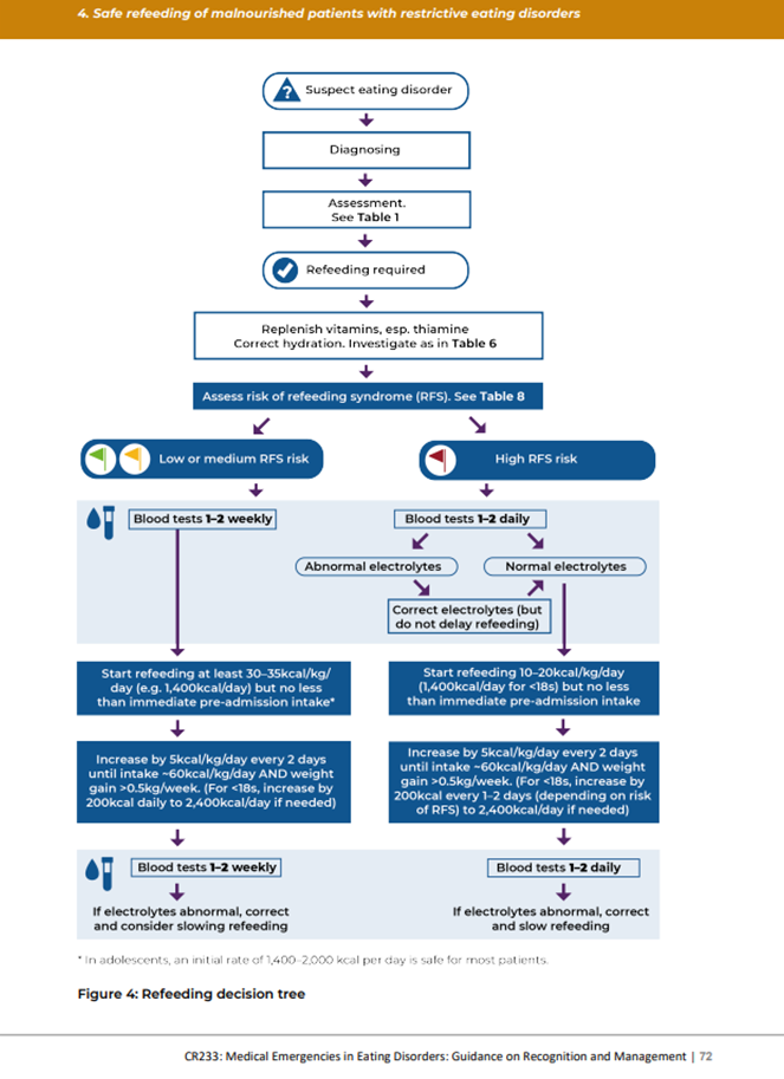
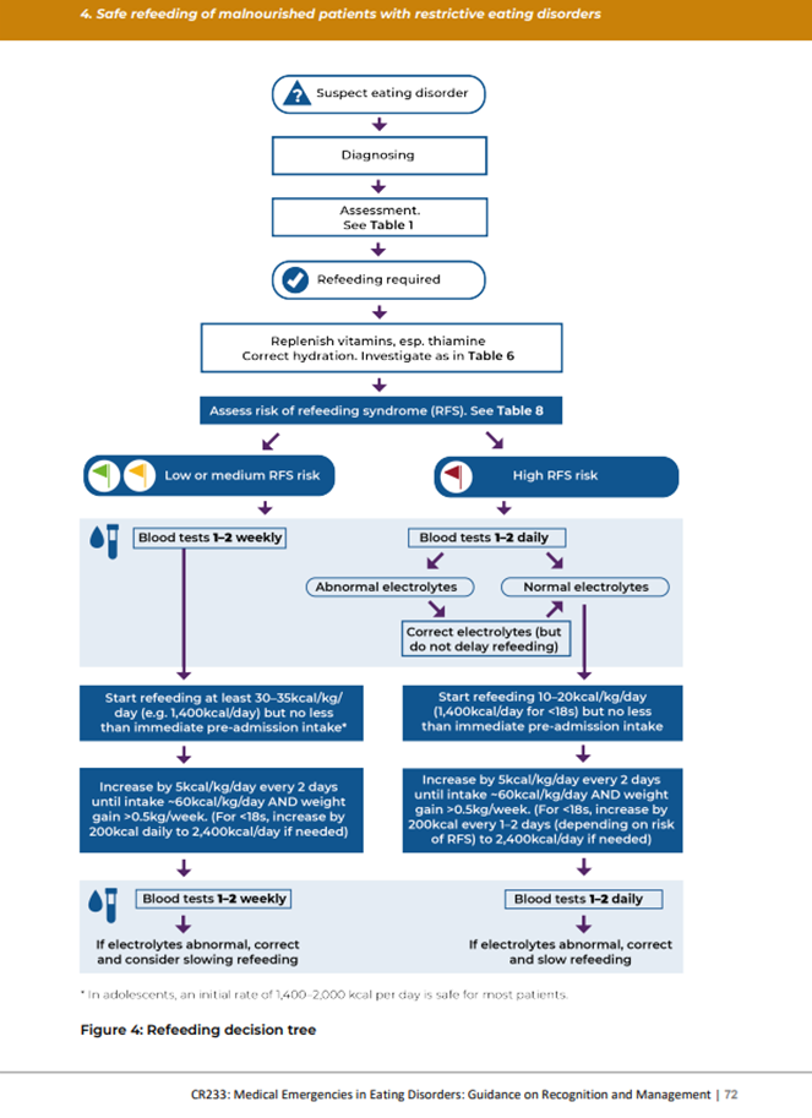
  • Follow the re-feeding decision tree below for blood monitoring and commencing nutrition. Note that there is specific information for <18’s. Most patients will be safe to commence Meal Plan 1 (1,400 kcal).
  • Do NOT start someone on a plan that is less than their pre-admission intake, useful to check with meal plans for reference. (it is unlikely that someone being admitted urgently will be managing more than 1,400 kcal, but important to assess pre-admission intake from patient and family/ carers).
  • Thiamine and Forceval should be commenced as per re-feeding guidelines before nutritional treatment is commenced: Thiamine 50 mg four times daily and Forceval capsule or soluble once daily.
  • Meal plans should be increased by at least 200 kcal every 1 to 2 days.
  • Increases in feeding should not be withheld unless K <2.5mmol/L, Mg <0.4mmol/L or PO4 <0.4mmol/L, provided that electrolytes are supplemented: BAPEN Position Statement on Electrolyte and Vitamin Replacement in Adult Patients with Severe Malnutrition, including those with Eating Disorders and other Related Conditions.
NOTE: Use clinical judgement in paediatric population.

Re-feeding Decision Tree Note: follow the guidance for <18’s


Oral meal plans

Commence a suitable meal plan based on the re-feeding decision tree. Most patients will be commenced on Meal Plan 1 (1,400 kcal), unless they are thought to be managing more than this.

Suitable Adaptions

  • Genuine food allergies, intolerances and dislikes (pre-eating disorder) should be confirmed by a parent or carer, and must be documented. Any fear-based foods due to the eating disorder should still be included in the meal plan.
  • If the patient is unable to take dairy products:
    • Swap Fortisip 200mL bottle for Fortisip Plant, which contains the same kcal and protein content.
    • Whole oat milk is the most equivalent plant-based milk to whole milk and should be requested from the kitchen.
    • Dairy-free meal and snack options, such as plant-based yoghurts and dessert options are available on request from the kitchen.
  • Ideally the patient should be given a copy of the meal plan without the kcal and Fortisip content. Do NOT provide patients with staff copies of the plan.
  • If the patient is unable to make a decision when ordering food, family or staff must order something from the plan on their behalf.

NHS Highland intranet access required for these documents: 

NG feeding (OOH)

Oral intake via meal plans and oral nutritional supplements should be the first line of treatment for children and young people with an eating disorder.

When NG feeding is required, this is ideally agreed as an MDT.

However, there may be emergency circumstances out of hours, where the patient is too medically unstable to wait for this. NG feeding may be indicated immediately in very high risk patients e.g. if they are not alert enough for oral intake or if they are requiring a significant amount of medical stabilisation.

Note ICU has separate guidance for enteral feeding and should continue to follow this.
Note: Detention under the mental health act may be required if the patient is not consenting to NG feeding.

Emergency NG Feeding Plan

  • This should only be used in an emergency situation as agreed with the Medical Consultant.
  • Discuss with on-call Psychiatrist if detention under the Mental Health Act is required.
  • Start thiamine 50 mg four times daily via NGT (or IV Vitamins B+C, 1 pair once daily, if preferred option) prior to starting NG feed.
  • Bloods should be monitored every 24 hours. Increase frequency to every 12 hours if any significant concerns.
  • Blood sugars should be checked four times daily.

Increases in feeding should NOT be withheld unless K <2.5mmol/L, Mg <0.4mmol/L or PO4 <0.4mmol/L, provided that electrolytes are supplemented: 

NOTE: use clinical judgment in paediatric population when calculating electrolyte replacement in the paediatric population and in low weight individuals.


Re-feeding

The most up-to-date evidence suggests that for adolescents, starting at 1,400 to 2,000 kcal/day, and increasing by at least 200 kcal/day up to around 2,400 kcal/day, is safe for all except patients at highest risk, provided that medical parameters are closely monitored.

  • Some patients require higher calorie intakes to gain weight.
  • A key consideration is that no patient should be started on a lower calorie amount than they were eating prior to admission.

Table 7: Clinical and laboratory features of refeeding syndrome (adapted from Rio et al., 2013)

Clinical and laboratory features of refeeding syndrome. Note: Not all features need to be present

  1. Severely low electrolyte concentrations:
    • Potassium <2.5mmol/l
    • Phosphate <0.32mmol/l
    • Magnesium <0.5mmol/l
  2. Peripheral oedema or acute circulatory fluid overload
  3. Disturbance to organ function including respiratory failure, cardiac failure or pulmonary oedema, raised liver transaminases

Adapted from MEED guidelines, Table 7 

Indicators of higher risk for refeeding syndrome

Predictors for the development of refeeding hypophosphataemia include low white blood cell count and higher haemoglobin level. Patients at the highest risk of refeeding syndrome are those with very low weight, minimal or no nutritional intake for more than 3 to 4 days, weight loss of over 15% in the past 3 months, and with abnormal electrolytes and medical comorbidities such as pneumonia or other serious infections, cardiac dysfunction or disease and liver damage (e.g. due to alcohol dependence) before refeeding (Table 8).

Any patient at high risk of refeeding syndrome should be managed in an acute medical environment with high-dependency facilities available if needed. In the majority, this will be an acute medical/paediatric unit but could be a SEDU if it is co-located on an acute hospital site with high dependency (HDU) facilities should they be required or unless there is an extenuating clinical circumstance which suggests another care environment is more appropriate as determined by the multidisciplinary team.

Table 8: Factors associated with the risk of refeeding syndrome

Clinical feature

High risk level

Management

Extremely low weight %mBMI <70% BMI <13 Cautious refeeding
Prolonged low intake Little or no intake for >4 days Cautious refeeding
Deranged baseline Low potassium, phosphorus, magnesium Measure levels up to twice per day initially and supplement as needed
Low white blood cell count <3.8 Monitor
At risk for low thiamine
The precise requirement for thiamine is not known
Low thiamine and other vitamins IV Vitamins B+C, oral thiamine and multivitamins
Medical comorbidities and / or complications Infection, e.g. pneumonia, cardiac disease, liver disease, alcohol misuse, other serious disease Should be discussed with an acute medical unit and HDU / ICU considered if the patient has a serious comorbidity. Refeed cautiously

Adapted from MEED guidelines, Table 8 

NHS Highland re-feeding guidelines: Policy for Prevention and Management of Re-feeding Syndrome in Adults 

Use clinical judgement for paediatric population and in all low weight individuals, who will likely need dose adjustment of medications and electrolyte replacement, due to their low weight.

OOH NG feeding plan

If someone is medically unstable and continuous NG feeding via pump is required e.g. the patient is not alert enough for oral intake, consider the plan below until they can be reviewed by a dietitian (see also re-feeding decision tree below – figure 4)

Day 1 to 2: 1,400 mL Nutrison @ 70 mL/hr x 20 hours, 4 hour break. (1,400 kcal, 56g protein)

Then: Increase by 200 kcal every 1 to 2 days, depending on refeeding risk, e.g.

Day 2 to 3: 1,600 mL Nutrison @ 80 mL/hr x 20 hours, 4 hour break. (1,600 kcal, 64g protein)

Day 3 to 4: 1,800 mL Nutrison @ 90 mL/hr x 20 hours, 3 hour break. (1,800 kcal, 72g protein)

  • 50 mL water flush pre and post feed.
  • Write feed prescription on purple NG feeding charts.
  • If milk-free or vegetarian feed required, swap Nutrison for Nutrison Soya (they are both 1 kcal/mL).

Additional fluids (IV or via NG), should be advised and prescribed by the medical team.

If there are concerns that the patient is very high risk of re-feeding syndrome, and a starting rate of 1,400 kcal is thought to be too much, discuss further with age appropriate services.

Note there is NOT a dietetic on-call service.

<16 year olds: Discuss with Aberdeen Paediatric Gastroenterology Consultant on-call.

  • Contact via Aberdeen Royal Infirmary switchboard

16 & 17 year olds: Discuss with Acute Consultant or Gastroenterology Consultant on-call.

  • Contact via Raigmore switchboard

Re-feeding Decision Tree Note: follow the guidance for <18’s

Abbreviations

  • BMI: Body mass index
  • CAMHS: Children and Adolescent Mental Health Service
  • HDU High dependency unit
  • ICU: Intensive care unit
  • m%BMI: Median percentage BMI
  • MDT: Multidisciplinary team
  • MEED: Medical emergencies in eating disorders
  • NG: Nasogastric 
  • NGT: Nasogastric tube
  • OOH: Out of hours
  • RFS: Refeeding syndrome
  • SEDU: Specialist Easting Disorder Unit

Editorial Information

Last reviewed: 30/06/2025

Next review date: 30/06/2026

Author(s): Child and Adolescent Mental Health Service.

Version: 1

Approved By: TAM subgroup of the ADTC

Reviewer name(s): G MacLean, Advanced CAMHS Dietitian, K Fraser, Principal Clinical Psychologist .

Document Id: TAM695