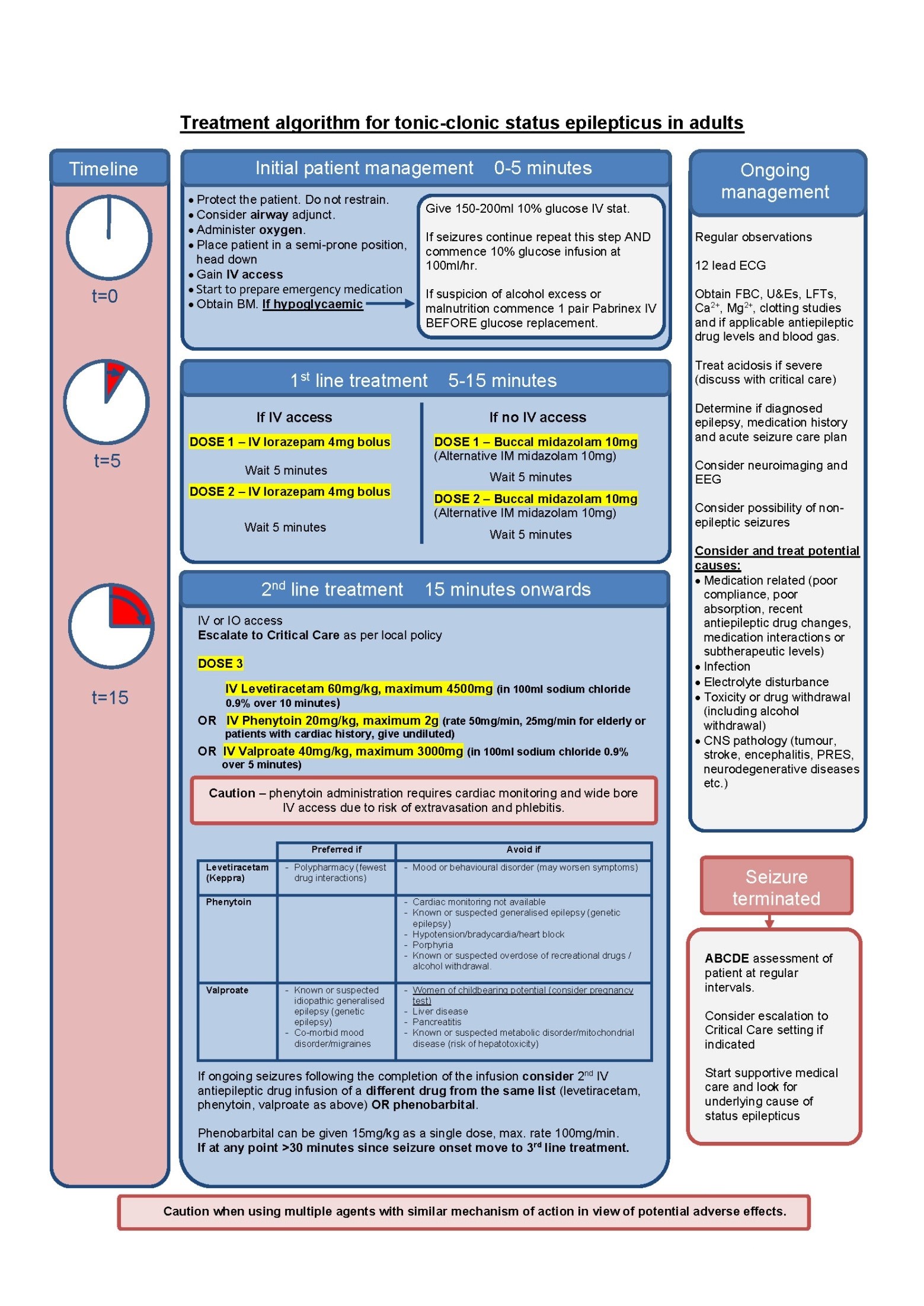
If seizures continue despite second line therapy, the patient is considered to have refractory status epilepticus. Mortality rates are high and as a result rapid initiation of IV anaesthetic agent should be commenced, titrated to suppress epileptic activity on EEG. Urgent EEG should be arranged.
The properties of each drug should be considered when selecting induction and maintenance agents.
Note that drugs selected for induction may be different to those chosen for maintenance.
Maintenance doses of anti-epileptic drugs should be continued in addition to the anaesthetic agent. The general anaesthetic agent should be tapered after a minimum of 24 hours and if seizures recur either clinically or electrographically the infusion re-commenced for a further 12 to 24 hours.
Suggested agents:
Propofol
- Induction: 1 to 2mg/kg bolus.
- Maintenance: up to 4mg/kg/hour titrated to effect, continuous infusion for a minimum of 24 hours.
Propofol has a rapid onset of action. It commonly causes hypotension, and vasopressor support is required in 22 to 55% of patients undergoing infusion.
Prolonged infusions can lead to propofol infusion syndrome (PRIS), which is a rare but life threatening complication characterised by metabolic acidosis, rhabdomyolysis, renal failure, hypertriglyceridaemia, refractory bradycardia and cardiac failure. The main risk factors are high infusion rate and infusion duration above 48 hours. Management is supportive, including discontinuation of propofol along with appropriate organ support.
OR Thiopental sodium
- Induction: 3 to 5mg/kg bolus.
- Maintenance: 3 to 5mg/kg/hour titrated to effect, continuous infusion for a minimum of 24 hours.
Thiopental is a barbiturate anaesthetic agent with good efficacy and a tendency to lower body temperature which may be beneficial in status epilepticus.
Thiopental does, however, have major disadvantages.
- Firstly, as an infusion it exhibits zero order kinetics and therefore tends to accumulate and have a long half-life. This can lead to an increased duration of ventilator dependency.
- Secondly, it has potent hypotensive and cardiorespiratory depressive effects, commonly requiring additional vasopressor support.
- Continuous ECG monitoring should be performed in all patients and senior colleagues involved with treatment decision making.
OR Ketamine
- Induction: 3mg/kg bolus.
- Maintenance: 1mg/kg/hr titrated to effect up to maximum 10mg/kg/hr, continuous infusion for a minimum of 24 hours.
There is an increasing body of literature supporting the use of ketamine as a third line agent in the management of refractory status epilepticus, with two randomised controlled trials assessing the efficacy and safety profile of ketamine to conventional anaesthetic agents for refractory status epilepticus currently in progress.
- Ketamine has a short half-life, reducing the likelihood of toxic accumulation.
- Compared with other drugs used for the treatment of refractory status epilepticus, respiratory depression and hypotension requiring vasopressor support are rarely observed.
- Note, interpretation of processed EEG monitoring such as bispectral index (BIS) may become unreliable when using ketamine infusion.
OR Midazolam
- Induction: 0.2mg/kg bolus.
- Maintenance: 0.05 to 0.5mg/kg/hour titrated to effect, continuous infusion for a minimum of 24 hours.
- Occasionally higher doses up to 50mg/hr may be used on consultant intensivist advice.
- The rationale for using the doses above 0.5mg/kg/hr need to be documented in case notes.
Midazolam is short acting, reducing the likelihood of toxic accumulation.
Caution should be taken in obese patients due to accumulation in the fat tissues and those with renal insufficiency.
It commonly causes hypotension, and vasopressor support is required in 30 to 50% of patients.
A number of studies suggest that breakthrough seizures occur more commonly with midazolam compared to other drugs used during this stage.


 TAM (Treatments and Medicines) NHS Highland