

 TAM (Treatments and Medicines) NHS Highland
- AOM: Acute otitis media
- CAPD: Continuous ambulatory peritoneal dialysis
- CF: Cystic fibrosis
- ITU: Intensive therapy unit
- LRTI: Lower respiratory tract infection
- NS: Neutropenic sepsis
- PA: Penicillin allergy
- PID: Pelvic inflammatory disease
Protected antimicrobials (Antimicrobial)

Warning
What's new / Latest updates
09/05/25:
- Secondary care process and flow chart updated to include HEPMA.
- Gentamicin approved indication changed from 3 days to 4 days.
04/06/25:
- In table 1, teicoplanin entry amended from 'Neutropenic sepsis' to 'Neutropenic sepsis, surgical prophylaxis'.
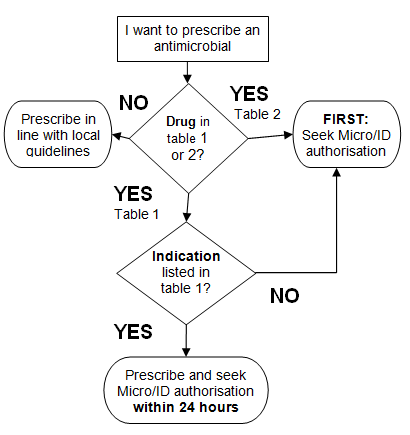
The antimicrobials in tables 1 and 2 are protected. Their use MUST be authorised by a consultant microbiologist or infectious diseases physician.
To ensure timely, appropriate treatment of certain infections, there are specific situations where this authorisation is not immediately required, as detailed in Table 1. However, this authorisation MUST be obtained within 24 hours, see below.
Table 1: List of drugs where an initial prescription is allowed for APPROVED INDICATIONS ONLY |
|
|
DRUG |
Approved Indication |
|
Ambisome® |
Neutropenic sepsis, endophthalmitis |
|
Caspofungin |
Neutropenic sepsis, ITU |
|
Cefotaxime |
Meningitis, paediatric sepsis |
|
Ceftazidime |
Cystic fibrosis, endophthalmitis, suspected CAPD peritonitis |
|
Ceftriaxone |
Meningitis, supraglottitis, orbital cellulitis, paediatric sepsis, PID |
|
Cefuroxime |
Paediatrics (LRTI, AOM) pyrexia in labour, Group B Strep |
|
Clindamycin |
Necrotising fasciitis, paediatrics, PID |
|
Gentamicin |
Up to 4 days for all indications |
|
Linezolid |
ITU for S aureus pneumonia |
|
Meropenem |
ITU, cystic fibrosis, neutropenic sepsis, severe sepsis (penicillin allergy), severe diabetic foot infection (penicillin allergy), necrotising fasciitis |
|
Piperacillin/tazobactam |
Neutropenic sepsis, severe diabetic foot infection |
|
Posaconazole |
Haematology prophylaxis |
|
Teicoplanin |
Neutropenic sepsis, surgical prophylaxis |
|
Voriconazole |
Neutropenic sepsis step down |
Table 2: List of drugs that require authorisation BEFORE prescribing |
|
Amikacin |
Authorisation in North Highland
In primary and secondary care, contact the duty consultant microbiologist in Raigmore via the laboratory on Ext 4206 (out of hours, via switchboard) or the infectious diseases physician via switchboard.
Primary care: These antimicrobials should only be used following discussion with, or on the advice of, an infection specialist. This should be recorded in the patient notes.
Secondary care: a code will be provided and must be written:
- in the notes as part of the Micro/ID discussion,
- as an 'Antibiotic Indication and Duration' note attached to the antimicrobial drug order on HEPMA.
This code is checked by Pharmacy staff and, if appropriate, the antimicrobial is supplied to the ward.
A supply is made for EACH patient so return unused stock to Pharmacy when the course is complete.
In the absence of a valid authorisation code, no antimicrobial will be supplied, and the ward pharmacist will contact the prescriber who is welcome to discuss with a consultant microbiologist.
DO NOT try to make up the code yourself – the codes are unique identifiers and fraudulent codes will be detected.
Authorisation in Argyll & Bute
Pharmacy stock for in-patient areas is provided by NHS Greater Glasgow and Clyde. Please note an equivalent authorisation process is not used by NHS GGC.
For glossary of terms see Glossary.