


Peripheral extravasation injury (Non-cancer) (Guidelines)

Warning

Audience

  • All NHS Highland
  • Secondary care only
  • Adults only

Extravasation is the inadvertent leakage of intravenous (IV) fluid or medication into extravascular tissue from a vascular access device such as a peripheral venous cannula (PVC). This guideline is for use for the management of peripheral venous extravasation not involving systemic anti-cancer therapies; please refer to separate NHS Highland POL004 Policy for the Management of Extravasation of a Systemic Anti-Cancer Therapy (SACT) including Cytotoxic Agents.pdf.

Extravasation

Extravasation has the potential to cause significant harm including pain, swelling, blistering and tissue damage and in some rare circumstances can result in compartment syndrome and even amputation. Therefore, it is vitally important that all steps are taken to minimise the risk of extravasation including daily review of PVC sites including visual infusion phlebitis score (VIP score) as per NHS Highland policy, monitoring of PVC sites during infusions and flushing PVC’s with 0.9% sodium chloride before and after administration of an IV drug. All staff should be alert to signs of possible extravasation which include increased resistance on injection, pain on injection and swelling around the cannula site.

Drugs have the potential to cause tissue damage through various pathophysiological mechanisms, including vasoconstriction and ischaemic necrosis, direct toxicity, osmotic damage and volume-related mechanical compression. The degree of tissue damage that can occur following extravasation is affected by a variety of factors including volume and type of drug administered. Some drugs have the potential to cause significant skin or tissue damage when they extravasate and these drugs are classified as vesicants (see Table 1 for examples).

Initial management

The initial management algorithm below summaries the initial actions that should occur once extravasation is detected or suspected to minimise ensuing tissue injury.
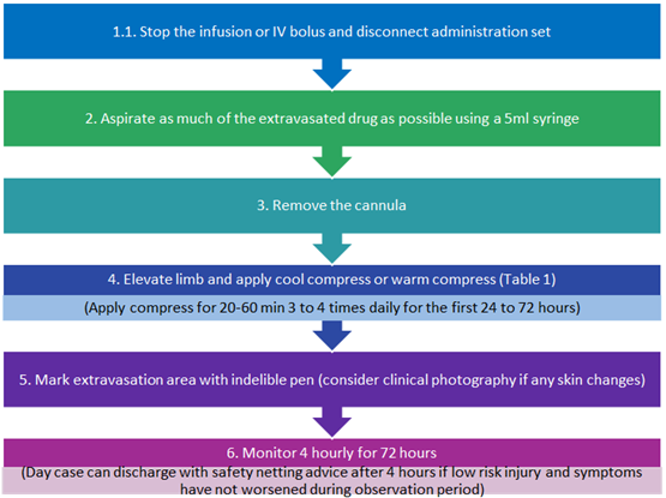

Risk Factors for Injury following Extravasation

A high-risk of ensuing tissue injury exists in the following scenarios:

  1. Vesicant drug extravasation (any volume)
  2. Moderate volume of irritant drug extravasation (>5ml)
  3. High volume (>50ml; smaller volume in young children) and suspicion of compartment syndrome (any agent)
  4. Grade 3 to 4 severity of any agent (see Table 2)

It is important to also consider patient factors including fragile skin (e.g., elderly, long term steroids), site of extravasation (smaller amounts of significant drugs will cause more damage/function loss in areas such as the dorsum of hand, wrist, antecubital fossa), and poor micro-circulation (e.g., diabetes, critically unwell).

Monitoring and Discharging Home

  • Administer analgesia as required
  • Use Millam assessment grading system (Table 2) to assess severity
  • In-patients should receive four-hourly observation for the first 72 h, if there are any concerns the NHS Lothian on call plastic surgery team (based at St John’s Hospital Livingston) should be contacted via Raigmore Hospital switchboard
  • Consider contacting the NHS Lothian on call plastic surgery team for all high risk events (patients with any of points 1 to 4 as listed above)
  • Outpatients and day-case patients (who do not meet any of the high risk criteria; points 1 to 4) can be discharged from hospital after an initial 4 hour period of observation, provided that any signs and symptoms that were present initially have improved or that new symptoms have not developed during the observation period. Consider admission for observation +/- contacting the plastic surgery team for high risk events
  • Because severe extravasation injuries can develop slowly, every patient who is discharged should be advised to seek medical attention from their GP or from the emergency department if they develop severe or progressive pain, paraesthesia, diminished range of motion, significant swelling, new skin ulceration or blistering or have any other concerns
  • Complete critical incident report form (Datix/Inphase) and document extravasation in clinical notes and in discharge letter

Table 1 Drug classification for extravasation

For advice on drugs not mentioned in this table please contact: 

  • Within hours: the ward pharmacist or Medicines Information (ext 4288).
  • Out of hours: on-call pharmacist, via Raigmore switchboard.
Agent risk level

Cool Compress

Warm Compress

Neutrals:
Very low risk agents

Non-vesicant / non-irritant drugs that do not cause damage when they infiltrate into the tissue; typically swelling and discomfort can occur

Sodium chloride 0.9%, Hartmann’s solution, Plasma-Lyte 148, glucose <10%


Irritants:
Low risk agents

Potential to cause pain, aching, tightness and phlebitis, rarely progressing to tissue breakdown

Ceftriaxone, cefuroxime, ciprofloxacin, clarithromycin, clindamycin, co-amoxiclav, co-trimoxazole, erythromycin, fentanyl, lidocaine, meropenem, morphine, nitroprusside, octreotide, omeprazole, potassium chloride, propofol, remifentanil Atracurium, etomidate, furosemide, metoclopramide, metronidazole, ondansetron, oxytocin, penicillin, suxamethonium

Vesicants:
High risk agents

Corrosive properties and have the potential to cause severe tissue destruction

Aciclovir, amiodarone, amphotericin B, diazepam, digoxin, ganciclovir magnesium sulphate, mannitol >5%, methylene blue, parenteral iron, phenobarbitone, sodium valproate, thiopental, vancomycin Adrenaline, aminophylline, calcium chloride, calcium gluconate, contrast medium, cyclizine, dantrolene, dobutamine, dopamine, esmolol, gentamicin, glucose ≥ 10%, haloperidol, ketamine, labetalol, lorazepam, midazolam, noradrenaline, phenylephrine, phenytoin, promethazine, rocuronium, sodium bicarbonate, sodium chloride ≥1.8%, TPN (total parenteral nutrition), vasopressin

Mixed extravasations:
drugs of the SAME classification

  • Those requiring a cold compress take precedence over applying a hot compress: apply a cold compress.

Mixed extravasations:
drugs in DIFFERENT classifications

  • Apply the temperature compression of the drug that takes precedence:
    • vesicants take precedence over irritants / neutrals
    • irritants take precedence over neutrals

Table 2 Milam Assessment Grading System

Grade 1

Grade 2

Grade 3

Grade 4

Pain at infusion site Pain at infusion site Pain at infusion site Pain at infusion site
No swelling Some swelling Marked swelling Marked swelling
Normal skin colour Normal skin colour Skin blanching Skin blanching
Capillary refill normal Capillary refill normal Capillary refill normal Reduced capillary refill
Normal pulses Normal pulses Normal pulses With or without decreased absent distal pulse
Skin intact, no erythema Skin intact, no erythema Skin intact With or without blistering or skin breakdown

Abbreviations

  • IV: intravenous 
  • PVC: peripheral venous cannula
  • SACT: Systemic Anti-Cancer Therapy
  • VIP: visual infusion phlebitis

Editorial Information

Last reviewed: 28/08/2025

Next review date: 28/08/2028

Author(s): Anaesthesia.

Version: 1

Approved By: TAM subgroup of the ADTC

Reviewer name(s): S Mackay, CT1 Anaesthetics.

Document Id: TAM700

References
  1. Billingham MJ, Mittal R. Peripheral venous extravasation injury. BJA Education. 2022 Dec; 23(2): 42-45 (2023).
  2. Barton A. Infiltration and Extravasation A Practical Guide. [Online]. National Infusion and Vascular Access Society. 2024 Feb [Accessed 26th May 2025]. Available from: https://www.medusaimg.nhs.uk/docs/NIVAS-Infiltration-and-Extravasation-toolkit-version-1-Feb-2024.pdf
  3. Ackermann M, Allen C, Armbruster W et al. Extravasation Reference. [Online]. Children’s Oncology Group Pharmacy Committee. 2015 Dec [Accessed 26th May 2025]. Available from: https://www.dir.iwk.nshealth.ca/Content/resources/ChemoExtravasationReference.pdf
  4. Young D. NHS Tayside Theatres and Critical Care Management of Peripheral Extravasation Injury Draft Guideline [Online]. NHS Tayside. [Accessed 04th November 2024]. Many thanks to Dr Young for access to NHS Tayside's draft guideline which was in progress in November 2024.