


Nausea and vomiting are unpleasant symptoms for people with life-limiting diseases. Management can be complex but is a vital component of palliative care. Management of nausea and vomiting is critical in maintaining control of all other symptoms that rely on oral medications.

There may be several potential contributory factors to consider, which may alter over the course of a patient’s illness. Meticulous history taking and regular reassessment are required. Persistent nausea can lead to a fear of vomiting, resulting in ’anticipatory‘ or ’total‘ nausea. It is, therefore, necessary to assess and treat the patient for anxiety in addition to providing antiemetic therapies.

Practice points

This guidance should not be used for people with the following conditions without specialist palliative care advice:

  • neurological conditions including Parkinson’s Disease, Parkinson’s Plus syndromes, and myasthenia gravis
  • complex metabolic conditions, such as porphyria
  • neuroendocrine tumours that are secreting hormones, such as phaeochromacytoma
  • a history of significant adverse effects with previous antipsychotics, such as neuroleptic malignant syndrome, serotonin syndrome, tardive dyskinesia, akinesia, need for long term procyclidine.
  • Always try to identify the underlying causes of nausea and vomiting and treat if possible (see Assessment).
  • For patients with chemotherapy-induced nausea and vomiting (CINV) and systemic therapy-induced nausea and vomiting, refer to local oncology guidelines. For persistent problems, seek specialist oncology advice. Comprehensive assessment is needed, including ascertaining whether the presence of nausea is intermittent or constant.
  • Assessments of hydration and nutritional status are essential and management should be considered in the context of the patient’s clinical picture (refer to Subcutaneous fluids guideline).
  • Consider non-pharmacological measures (refer to Non-pharmacological management).
  • Correct any reversible causes of nausea and vomiting when possible (eg renal failure, hypercalcaemia, hyponatraemia, hyperglycaemia, constipation, symptomatic ascites, cerebral oedema or raised intracranial pressure).
  • Deprescribe potentially inappropriate medication to reduce tablet burden and polypharmacy where possible (see the Polypharmacy guidance).
  • If bowel obstruction is identified, manage according to the guideline on Bowel obstruction.
  • When pharmacological management is indicated, consider timing of medications, eg administering antiemetics before meals when appropriate.
  • Select an antiemetic appropriate to the likely identified cause.
  • Consider the formulation of drugs and route of administration of medication as:
    • the oral route may not provide adequate absorption or be available as a result of nausea (which inhibits gastric emptying) or vomiting
    • swallowing tablets may trigger nausea, therefore, liquids or crushable formulations may be preferred. Additionally, it may take longer for the medication to absorb as nausea is frequently associated with delayed gastric emptying
    • buccal or sublingual medication administration may be helpful if swallowing is difficult
    • the transdermal or parenteral route may be used if the oral route is not appropriate or to reduce tablet burden.
  • Consider switching from transdermal or parenteral routes to the oral route if symptoms are well controlled and clinically appropriate.
  • A broad-spectrum antiemetic, such as levomepromazine, may be indicated if multiple concurrent factors are present, eg biochemical triggers of nausea and oesophageal irritation occurring concurrently.
  • If first-line treatment is only partially effective, a combination of antiemetics may be appropriate.
  • Try to avoid the concurrent prescribing of prokinetics (eg metoclopramide) and anticholinergics (eg cyclizine) medication. The anticholinergics will diminish the prokinetic effect.
  • It may be necessary to combine antiemetics with adjuvants such as corticosteroid and/or benzodiazepine.


Assessment

  • Carry out a holistic assessment, including:
    • discussing goals and what matters to the patient, whether there is a desire to eat, whether goals are nutrition or eating for comfort, or simply relief from nausea and vomiting
    • the effects on quality of life and social functioning
    • spiritual distress.
  • It may be necessary to take a separate history for both nausea and vomiting, to cover:
    • triggers, volume, pattern
      • including whether nausea is constantly or intermittently present
    • exacerbating and relieving factors
    • medications tried so far, including individual and combinations of medicines and routes used
    • bowel habit
    • medication that may:
      • contribute to the nausea and vomiting, taking note of whether any new medications have commenced recently
      • exacerbate the clinical picture, such as worsening acute kidney injury
      • not be effective because of the nausea and vomiting
    • reflux or regurgitation. Identify and treat and, if uncontrolled with medication, consider seeking advice from gastroenterology colleagues. Further interventions, such as, endoscopy or stenting, can be considered.
    • other concurrent symptoms, such as dizziness, cranial nerve palsies, diplopia (suggestive of an intracerebral cause), or postural hypotension
    • oral intake as part of an assessment of nutritional and hydration status
    • presence of anxiety and fear of vomiting
    • relevant background medical conditions which will influence the management plan and choice of antiemetics, eg Parkinson’s or Parkinson’s Plus syndromes, ischaemic heart disease.
  • Examination:
    • general review for signs of dehydration, sepsis, drug toxicity
    • nervous system examination, including cranial nerve examination
    • abdominal examination for relevant signs, including cachexia, organomegaly, ascites, bowel sounds, succussion splash
    • check temperature, pulse and respiration
    • fluid status, including mucous membranes, skin turgor, heart rate and pulse character
    • examine the contents of vomit bowls if available.
  • Blood investigations, where appropriate, may include:
    • urea and electrolytes
    • liver function tests
    • calcium, magnesium, phosphate
    • blood glucose
    • therapeutic drug monitoring where indicated (eg digoxin, theophylline).
  • Consider the appropriateness of performing an electrocardiogram (ECG) to measure QTc as many antiemetics increase the risk of QTc prolongation.
  • Consider urinary infection and treat if present.
  • Consider bowel obstruction and, if present, manage according to the Bowel obstruction guideline. Associated features may include:
    • abdominal pain or discomfort, especially if colicky in character
    • large volume vomits which may be bilious or feculent, triggered by moving, with no preceding nausea
    • constipation
    • reduced or absent flatus
    • abdominal distension
    • tinkling or scanty bowel sounds
    • worsening of abdominal pain or cramping when prokinetic drugs (eg metoclopramide, domperidone, erythromycin) are administered.

Non-pharmacological management

Please see the NHS Inform information leaflet on eating and drinking for advice for the patient and their carer.

Non-pharmacological measures should be considered alongside the prescribing of appropriate antiemetics. Measures include:

    • including thoroughly cleaning dentures, once removed, to help prevent infections.
    • parenteral hydration if appropriate
    • artificial saliva spray to keep the mouth moist
    • supporting the patient to drink, if possible, even if only sipping small amounts of fluid throughout the day.
  • Regularising bowel habit as constipation is a relatively common cause of nausea.
  • Regular small palatable portions of food rather than large meals.
  • Considering modified food consistencies.
  • Plain foods and foods served at room temperature, which may be more manageable for the patient.
  • Considering smells or tastes. Some may trigger nausea and vomiting, while others may help reduce the sensation of nausea, depending on the individual.
  • Avoiding exposure to food preparation and cooking smells.
  • Timing food after antiemetics have taken effect.
  • A calm and reassuring environment.
  • Comfortable, loose-fitting clothing to reduce discomfort around the waist.
  • Positional changes, depending on the underlying cause, eg reducing intra-abdominal pressure.
  • Acupuncture or aromatherapy, if available.
  • Use of isopropyl alcohol wipes for aromatherapy (inhalation) may be helpful in reducing nausea. Evidence of its efficacy is not yet clear but it is unlikely to cause adverse effects.
  • Use of a room humidifier may alleviate dry mouth.
  • Psychological approaches.

Pharmacological management of constant nausea and vomiting


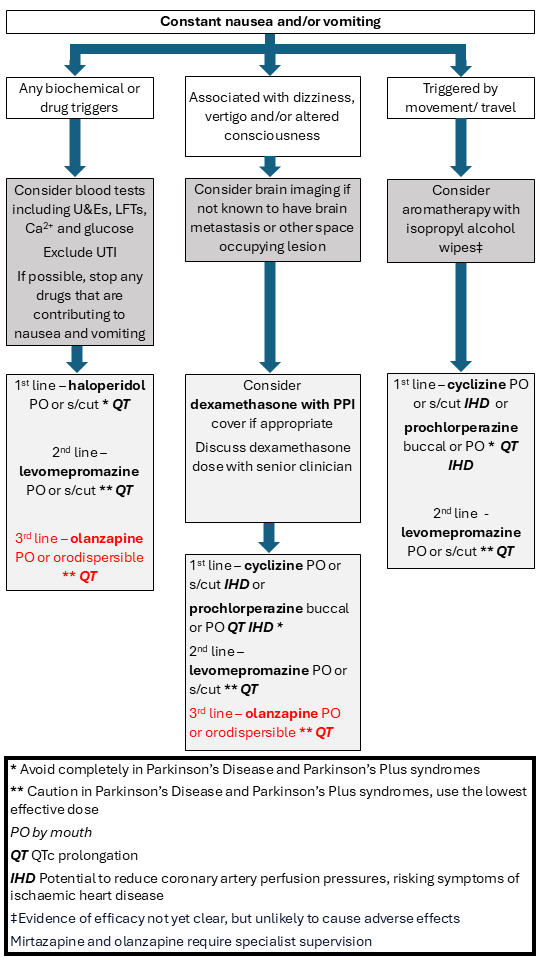
Constant nausea and/or vomiting flowchart
Click to open (PDF)


1. Biochemical (stimulation of chemoreceptor trigger zone) or drug-induced nausea and vomiting

Clinical picture

  • persistent, often severe nausea
  • little relief from vomiting or retching
  • absence of specific triggers

Cause

  • Stimulation of chemoreceptor trigger zone (CTZ) by
    • drugs - systemic anticancer treatments, opioids (also delay gastric emptying), NSAIDs, syrupy liquids, antibiotics, antidepressants, anticonvulsants, digoxin or other cardiac drugs, alcohol
    • metabolic triggers - hypercalcaemia, hyponatraemia, ketoacidosis, infection, hypoadrenalism, circulating toxins, hormone imbalance
    • carcinomatosis or chronic inflammation (cytokine-induced).

Treatment

  • treat underlying metabolic imbalances if appropriate and possible

For nausea and vomiting:

  • First line - QThaloperidol 500 micrograms orally at night or twice daily, or 500 micrograms to 1 mg subcutaneously daily (start with lower doses in patients with renal failure and elderly and frail patients) or 1 mg over 24 hours by continuous subcutaneous infusion titrated to effect (unlicensed use). Avoid in patients with Parkinsons or Parkinsons-plus syndrome.
  • Second line - QT†levomepromazine 2.5 mg to 6.25 mg orally at night or twice daily; 2.5 mg by subcutaneous injection 12 hourly as needed or 5 mg to 10 mg in 24 hours by continuous subcutaneous infusion. May need to give subcutaneous injection more frequently initially, for example 3 hourly, to control symptoms. Once the settling dose is established this can be converted into a continuous subcutaneous infusion over 24 hours at the same dose. A steady state is not reached for 3 days. Use with caution in patients with Parkinsons or Parkinsons-plus syndrome and use the lowest effective dose.


2. Intracranial disorders

Clinical picture

  • headache
  • altered consciousness level
  • vertigo or dizziness with nausea
  • movement-related sickness

Cause

  • raised intracranial pressure (ICP) as a result of a space-occupying lesion or base of skull tumour

Treatment

  • Consider a corticosteroid to reduce intracranial pressure (dexamethasone 8 mg to 16 mg daily). The appropriate starting dose should be discussed with a senior clinician. Aim to reduce the dose after 3 to 5 days, depending on side effects and individual factors, and stop or reduce to the lowest maintenance dose.

For nausea and vomiting:

  • First line – cyclizine 50 mg orally or 25 mg subcutaneously (unlicensed route) three times per day or 50 mg to 150 mg over 24 hours via subcutaneous infusion (unlicensed route).
  • QTprochlorperazine 3 mg buccal or 5 mg to 15 mg orally. Avoid in patients with Parkinsons or Parkinsons-plus syndrome.
  • Second line - QT†levomepromazine 2.5 mg to 6.25 mg orally at night or twice daily; 2.5 mg by subcutaneous injection 12 hourly as needed or 5 mg to 10 mg in 24 hours by continuous subcutaneous infusion. May need to give subcutaneous injection more frequently initially, for example 3 hourly, to control symptoms. Once the settling dose is established this can be converted into a continuous subcutaneous infusion over 24 hours at the same dose. A steady state is not reached for 3 days. Use with caution in patients with Parkinsons or Parkinsons-plus syndrome and use the lowest effective dose.

For persistent problems, seek specialist advice.


3. Movement or travel-induced nausea and vomiting

Clinical picture

  • vertigo or dizziness with nausea
  • movement-related sickness

Cause

  • Vestibular nerve or inner ear stimulation caused by
    • ototoxicity
    • middle ear problems
    • travel

Treatment

  • First line – cyclizine 25 mg to 50 mg orally or subcutaneously (unlicensed route) three times per day or 50 mg to 150 mg over 24 hours via subcutaneous infusion (unlicensed route) or QTprochlorperazine 3 mg buccal or 5 mg to 15 mg orally. Avoid use of prochlorperazine in patients with Parkinsons or Parkinsons-plus syndrome.
  • Second line - QT†levomepromazine 2.5 mg to 6.25 mg orally at night or twice daily; 2.5 mg by subcutaneous injection 12 hourly as needed or 5 mg to 10 mg in 24 hours by continuous subcutaneous infusion. May need to give subcutaneous injection more frequently initially, for example 3 hourly, to control symptoms. Once the settling dose is established this can be converted into a continuous subcutaneous infusion over 24 hours at the same dose. A steady state is not reached for 3 days. Use with caution in patients with Parkinsons or Parkinsons-plus syndrome and use the lowest effective dose.

For persistent problems, seek specialist advice.


Pharmacological management of intermittent nausea and vomiting

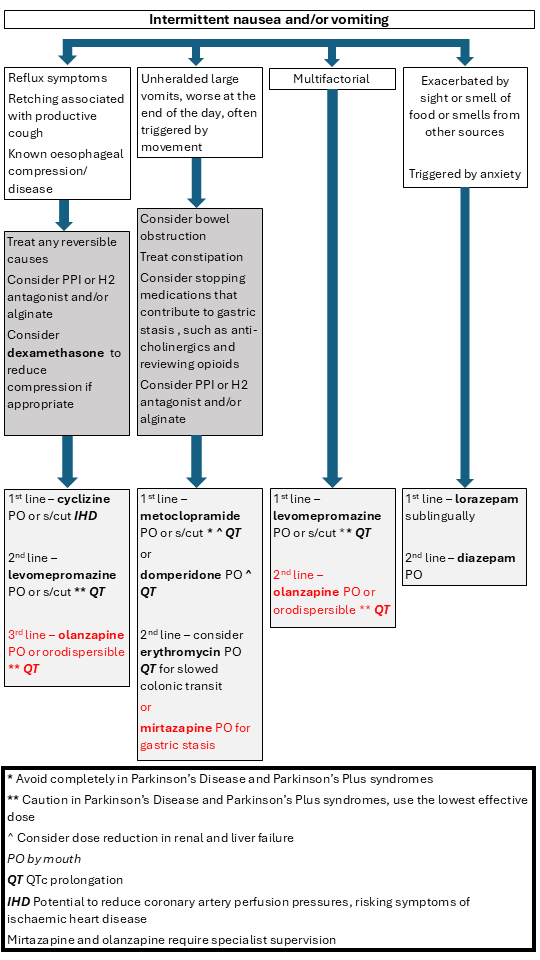
Flowchart: Intermittent nausea and/or vomiting
Click to open (PDF)


1. Oral, pharyngeal or oesophageal irritation

Clinical picture

  • worse on eating
  • reflux symptoms
  • retching associated with productive cough

Cause

  • cranial nerve irritation (vagal and glossopharyngeal) caused by
    • intrinsic or extrinsic (eg mediastinal) compression by tumour
    • secretions or sputum stimulating the gag reflex
    • acid reflux
    • inflammation, including drug related (eg oesophagitis secondary to doxycycline)
    • infection (eg candida, herpes simplex)
    • foreign body (eg stent)

Treatment

  • Treat reversible causes, for example, acid reflux, infection, secretions, obstruction.
  • Deprescribe where possible.
  • First line – cyclizine 50 mg orally or 25 mg subcutaneously (unlicensed route) three times per day or 50 mg to 150 mg over 24 hours via subcutaneous infusion (unlicensed route).
  • Second line - QT†levomepromazine 2.5 mg to 6.25 mg orally at night or twice daily; 2.5 mg by subcutaneous injection 12 hourly as needed or 5 mg to 10 mg in 24 hours by continuous subcutaneous infusion. May need to give subcutaneous injection more frequently initially, for example 3 hourly, to control symptoms. Once the settling dose is established this can be converted into a continuous subcutaneous infusion over 24 hours at the same dose. A steady state is not reached for 3 days. Use with caution in patients with Parkinsons or Parkinsons-plus syndrome and use the lowest effective dose.

For persistent problems, seek specialist advice. 


2. Motility disorders 

Clinical picture

  • intermittent large volume vomit usually relieves symptoms temporarily
  • early satiation
  • reflux, hiccup
  • often little nausea until immediately prior to vomit

Cause

  • gastric stasis
  • gastric outlet obstruction
  • pseudo-obstruction, subacute obstruction, complete obstruction (intestinal)

Arising from

    • autonomic neuropathy (paraneoplastic)
    • drugs (including opioids and anticholinergic drugs)
    • metabolic trigger (eg hypercalcaemia)
    • mechanical obstruction, tumour, nodes, enlarged liver (leading to squashed stomach)
    • if there is large volume vomiting or colicky bowel pain, especially colic caused by a prokinetic agent, exclude complete bowel obstruction and refer to Bowel obstruction guideline.

Treatment

  • Before commencing a prokinetic it is important to ensure that the patient is not in complete obstruction and is not experiencing colic. If bowel obstruction is present, manage according to the Bowel obstruction guideline. If uncertain, seek specialist advice.
  • Review the patient’s medications, including opioids and consider deprescribing medicines contributing to gastric stasis, if clinically appropriate.
  • Reduction of gastric acid with medications such as proton pump inhibitors (PPIs) or H2 antagonists should be considered.
  • If extrinsic or intrinsic compression is present, consider stent insertion or a corticosteroid (dexamethasone 4 mg to 8 mg daily). The appropriate starting dose should be discussed with a senior clinician. Aim to reduce the dose after 3 to 5 days, depending on side effects and individual factors, and stop or reduce to the lowest maintenance dose.

For nausea:

  • First Line - QTmetoclopramide 10 mg orally up to four times a day or 30 mg to 60 mg/24 hours by subcutaneous infusion (unlicensed route, dose and duration) or
  • QTdomperidone 10 mg orally up to three times a day if the patient has an akinetic rigid disorder, such as Parkinson’s, or is at high risk of extrapyramidal/tardive dyskinesia side effects (eg females under the age of 50, people on long-term procyclidine or antipsychotics, etc). 

Treatment with metoclopramide or domperidone lasting longer than one week will require closer monitoring because of the cardiac risks.  In patients with renal or liver failure doses should be reduced to 5 mg up to 3 times a day initially. Specialists may recommend higher doses.

  • Second Line - QTErythromycin orally starting with 50 mg to 100 mg four times daily (before meals and at bedtime), increasing in increments of 25 mg to 50 mg daily until reaching a maximum dose of 250 mg four times daily if needed.


Treatment with erythromycin lasting longer than one week will require closer monitoring due to cardiac risks. 

Prokinetic agents may trigger colic or oesophageal spasm.

For persistent problems, seek specialist advice. 


3. Multifactorial

Treatment

  • Consider potential causes and treat appropriately. If nausea and vomiting persist, use levomepromazine as a broad-spectrum antiemetic.
  • First line - QT†levomepromazine 2.5 mg to 6.25 mg orally at night or twice daily; 2.5 mg by subcutaneous injection 12 hourly as needed or 5 mg to 10 mg in 24 hours by continuous subcutaneous infusion.  May need to give subcutaneous injection more frequently initially, for example 3 hourly, to control symptoms. Once the settling dose is established this can be converted into a continuous subcutaneous infusion over 24 hours at the same dose. A steady state is not reached for 3 days.

Use levomepromazine with caution in patients with Parkinsons or Parkinsons-plus syndrome and use the lowest effective dose.

  • If a transmucosal option is preferred then consider:
    • first line - QTprochlorperazine 3 mg buccal
    • second line – consult specialist palliative care about suitability for orodispersible olanzapine
    • note that these transmucosal options are less likely to be effective than levomepromazine
    • avoid in patients with Parkinsons or Parkinson's plus syndrome.
  • Consider higher centre origin, for example, pain, fear, anxiety.

For persistent problems, seek specialist advice. 


4. Higher centres (pain/fear/anxiety) 

Clinical picture

  • exacerbated by the sight or smell of food or smells from other sources
  • triggered by anxiety
  • associated with pain

Treatment

Refer to Pain assessment and Pain management guidelines where appropriate.

  • Patients with nausea associated with anticipation or anxiety may respond to a benzodiazepine, such as:
    • first line – lorazepam (scored tablet) 500 micrograms to 1 mg sublingually. Lorazepam is not licenced for sublingual administration. An oral solution and 250 microgram tablets are also available. 
    • second line – diazepam 2 mg to 5 mg orally; or midazolam 2 mg to 5 mg subcutaneously or 5 mg to 10 mg over 24 hours in a syringe pump.

For persistent problems, seek specialist advice.


5. Refractory nausea and vomiting

  • If nausea and vomiting persist reassess, reconsider the possible causes and change the treatment approach if appropriate. If there is no improvement, seek specialist advice.
  • Despite logical and appropriate treatment, the patient may continue to vomit, especially if there is an intracerebral mass or duodenal or gastric outflow or bowel obstruction.
  • Consider the possibility of bowel obstruction (refer to the Bowel obstruction guideline). Colicky abdominal pain after taking a prokinetic drug may suggest bowel obstruction.

Emerging therapies

Treatment

For persistent problems, not responsive to initial management steps above, seek specialist palliative care advice. Specialists may consider the need for further investigation, addition of adjuncts, or stepping up to emerging therapies.

Olanzapine and mirtazapine should only be commenced on specialist advice.

  • There is a growing evidence base for the role of olanzapine 2.5 mg to 5 mg orally at night in the management of patients with nausea and vomiting. Most of the evidence is in patients with chemotherapy-induced nausea and vomiting (CINV), with evidence of efficacy in patients with palliative care needs. Olanzapine is also available as an orodispersible tablet.
  • There is some evidence that mirtazepine may be helpful in the management of patients with nausea and vomiting, particularly when associated with gastric stasis. It could, therefore, be considered where this might confer additional symptomatic benefits (eg mood, sleep).


References

Cox L, Darvill E, Dorman S. Levomepromazine for nausea and vomiting in palliative care. 2015. Available from: http://onlinelibrary.wiley.com/doi/10.1002/14651858.CD009420.pub3/abstract.

Dietz I, Schmitz A, Lampey I, Schulz C. Evidence for the use of Levomepromazine for symptom control in the palliative care setting: A systematic review. BMC Palliative Care. 2013;12 (1). Available from: https://bmcpalliatcare.biomedcentral.com/counter/pdf/10.1186/1472-684X-12-2.pdf

Dewhurst, Felicity, and others, Challenging Cases in Palliative Care, Challenging Cases (Oxford, 2024; online ed, Oxford Academic, 1 May 2024), https://doi.org/10.1093/med/9780192864741.001.0001 [accessed 04 Mar 2025].

Economos G, Lovell N, Johnston A, Higginson IJ. What is the evidence for mirtazapine in treating cancer-related symptomatology? A systematic review. Supportive Care in Cancer. 2019 Dec 19;28(4):1597–606. Available from: https://doi.org/10.1007/s00520-019-05229-7. Methodology quality rating: acceptable (2+)

Ji M, Cui J, Xi H, Yang Y, Wang L. Efficacy of olanzapine for quality of life improvement among patients with malignant tumor: A systematic review. Cancer Reports. 2019 Feb 26;2(4). Available from: https://doi.org/10.1002/cnr2.1167. Methodology quality rating: acceptable (2+)

Murray-Brown F, Dorman S. Haloperidol for the treatment of nausea and vomiting in palliative care patients. 2015 Available from: http://onlinelibrary.wiley.com/doi/10.1002/14651858.CD006271.pub3/abstract.

National Institute for Health and Clinical Excellence (NICE). Palliative care – nausea and vomiting. Clinical Knowledge Summary.2021. Available from Palliative care - nausea and vomiting | Health topics A to Z | CKS | NICE [Accessed 04 Mar 2025]

Saudemont G, Prod’Homme C, Da Silva A, Villet S, Reich M, Penel N, et al. The use of olanzapine as an antiemetic in palliative medicine: a systematic review of the literature. BMC Palliative Care. 2020 Apr 22;19(1). Available from: https://doi.org/10.1186/s12904-020-00559-4. Methodological quality rating: low (2-)

Sutherland A, Naessens K, Plugge E, Ware L, Head K, Burton MJ, et al. Olanzapine for the prevention and treatment of cancer-related nausea and vomiting in adults. Cochrane Library. 2018 Sep 21;2018(9). Available from: https://doi.org/10.1002/14651858.cd012555.pub2. Methodological quality rating: high (1++)

Wilcock A, Howard P, Charlesworth S. Palliative Care Formulary, 8th ed. England: Pharmaceutical Press; 2022. Available from: Medicines Complete: Palliative Care Formulary

How this guideline was developed

This guideline was published in 2025. It updates the nausea and vomiting guideline from 2019. This guideline is based on an evidence review. Where there were gaps in the evidence, advice is based on the expert opinion of the nausea and vomiting guideline development group.

Nausea and vomiting guideline development group:

Dr Steinunn Boyce (Chair)

Consultant in Palliative Medicine, NHS Fife

Ms Mairi Armstrong

Macmillan Nurse Facilitator, Palliative Care, NHS Greater Glasgow and Clyde

Ms Sandra Campbell

Macmillan Partnership Nurse Consultant Palliative Care, Scottish Ambulance Service

Ms Siobhan Dobie

Pharmacist, NHS Lanarkshire

Dr Beth Goundry

Specialty Doctor in Palliative Medicine, NHS Greater Glasgow and Clyde

Ms Pamela Millar

Surgical Clinical Pharmacist, NHS Lanarkshire

Dr Shaun Peter Qureshi

Specialty Doctor in Palliative Medicine, Sobell House Hospice, Oxford

Mr Paul Wilson

Specialist Palliative Care Pharmacist, NHS Fife

Consultation

The draft guideline was available on the SIGN website for a month to allow all interested parties to comment.  All comments received were addressed by the guideline development group and recorded in the consultation report.

The Scottish Palliative Care Guideline group are grateful to all those who contributed to the consultation.


Editorial

As a final quality control check, the guideline was reviewed by an editorial group to ensure that the reviewers’ comments have been addressed adequately and that any risk of bias in the guideline development process as a whole has been minimised. The editorial group for this guideline was as follows:

Dr Roberta James

SIGN Programme Lead, Healthcare Improvement Scotland

Dr Safia Qureshi

Director of Evidence and Digital, Healthcare Improvement Scotland

Dr Anna Sutherland

Chair, Scottish Palliative Care Guideline

Dr Angela Timoney

Chair of SIGN, Healthcare Improvement Scotland