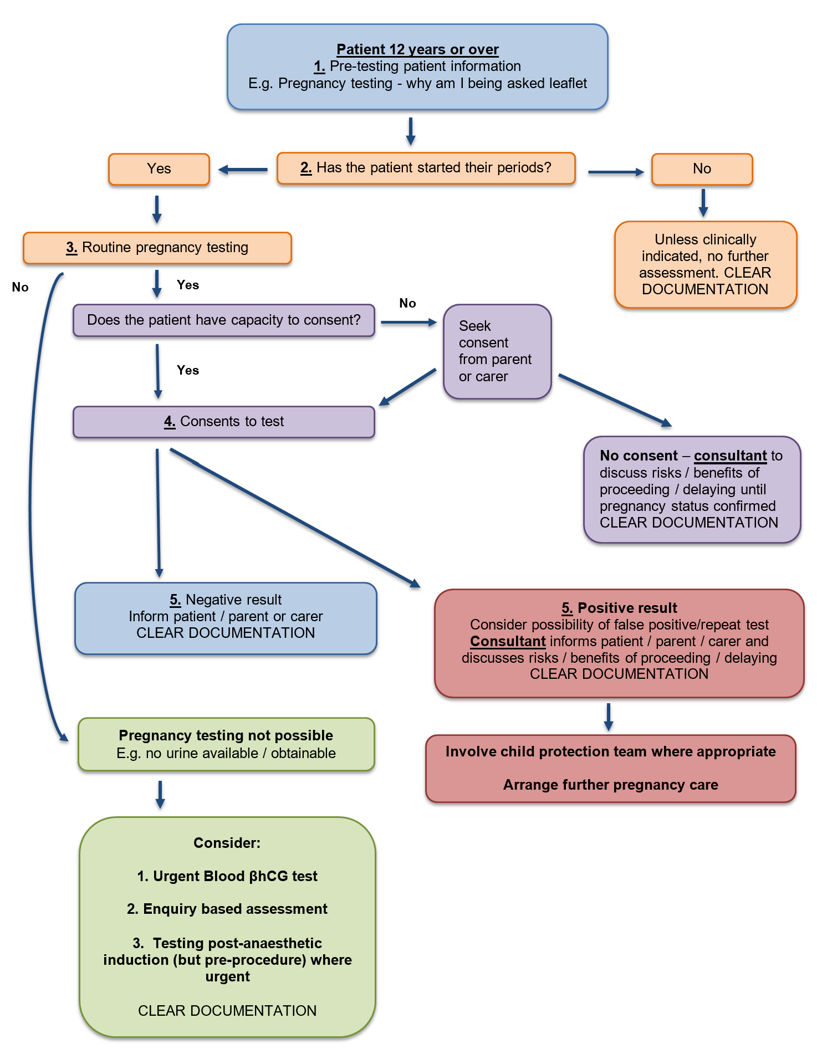
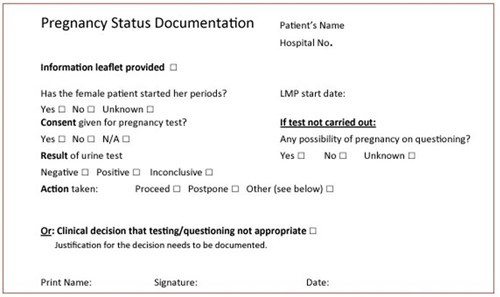
See below for more information regarding each numbered flowchart step
1. Pre-testing patient information (see also Patient Information Leaflet)
If possible patients should be informed at the earliest opportunity. The testing should be part of a routine assessment process, and this should be explained to the patient and parents/carers where appropriate. This will aid greatly in reducing elements of embarrassment and sensitivity during subsequent discussions on admission.
Pre-operative pregnancy testing should ideally be discussed at the surgical or pre-op assessment clinic and information given about the reasons for testing, including the Patient Information Leaflet.
The pregnancy test itself must be carried out on the day of the procedure.
For unplanned admissions, the same level of information and discussion should take place as far as possible, as soon as the responsible clinical team identifies the need for pregnancy testing.
Female patients with capacity to consent have the right to have all discussions in a sensitive, confidential manner separately from their parents/carers. Any information disclosed should be kept in confidence unless there are overriding safeguarding considerations.
It is sometimes difficult to contrive a way to separate patients from their parents to ask sensitive questions, but it might be enough to suggest that as the patient is nearly an adult, there are a couple of questions they may like to answer by themselves in private. The parents may then be asked to leave the room, or the patient given the opportunity to move to a private space with the healthcare professional. Given the responsibility that parents have for the conduct and welfare of their children, professionals should encourage the patient, at all points, to share information with their parents and carers whenever safe to do so.
2. Has the female started her periods?
A wide variance in the onset of menarche is reported. However, data suggest the likelihood of pregnancy in those under 13 years presenting in the hospital is negligible. As a consensus the age limit has been agreed to 12 years and over unless clinically indicated otherwise.
Radiology will require confirmation of last menstrual period regardless. The referrer may overrule this process, but accepts responsibility for the decision if it transpires that the patient is pregnant.
3. Routine Pregnancy Testing versus Enquiry Based Assessment
There are two possible options for ascertaining pregnancy status in female patients – consented pregnancy testing or direct enquiry. The testing should be considered as first line approach. In cases when this is not possible, practical or feasible, enquiry based assessment should be performed and documented.
In some cases the clinician caring for the patient may consider the possibility of pregnancy to be so remote that neither enquiry nor testing are necessary. This decision should however be documented.
Patients should be questioned sensitively about whether they have started their periods. The start date of their last period should be recorded and they should be asked if there is any possibility they could be pregnant, qualifying this by asking if they are sexually active in a way that could result in pregnancy. They might also be asked at this stage whether they are taking oral contraceptive medication or using other contraceptive methods.
If the patient reveals a possibility of pregnancy, as yet undetected or undisclosed, she should be consented for testing. In the cases when consent is denied, the responsible clinical team must discuss further actions. Safeguarding implications may apply.
4. Consent
Covert pregnancy testing may be seen as an infringement of human rights and must not occur.
Clearly documented verbal consent should be obtained from the patient, or parent/carer if the child is not considered competent to consent. Clear explanation might be necessary and sensitive handling of the discussion is required particularly where the age of the patient or indications of cultural sensitivity around premarital or under-age sexual activity are considerations. It is essential to have a professional interpreter or independent advocate if this helps the patient or family to make decisions. The GMC guidance on personal beliefs and medical practice provides further information5.
For some procedures, e.g. emergencies, the patient may not have capacity to give consent. Parental consent to perform a pregnancy test on a minor lacking capacity in an emergency situation is not required provided the treatment is immediately necessary to save the patient’s life or to prevent a serious deterioration of the patient’s or unborn fetus’ condition.
The legal framework on consent and confidentiality with particular relevance to children and young people is covered by the GMC publication ‘0-18 years: Professional Standards’6.
In cases where consent is denied, the clinical team must explain the risks of proceeding. Effort should be made to quantify the risk so that the patient/parent can make an informed decision. In situations where the risk of an undetected fetus would be considered unacceptable, the lead clinician is justified in refusing to undertake the procedure/treatment/investigation.
The ultimate responsibility for these discussions & documentation is with the senior clinical lead in the team.
5. Results
All results must be documented in the notes.
Four possible readings could be obtained following ward-based urine pregnancy testing:
1. Negative – the patient (or her parent/carer, if the she is not competent) must be informed of the result in a confidential manner.
2. Borderline – must be followed by a laboratory blood βhCG test.
3. Invalid – must be repeated and if the test fails again a laboratory blood βhCG test must be carried out.
4. Positive – a laboratory blood βhCG test to confirm pregnancy should be organised.
If the result is positive, the lead clinician should be informed immediately and should meet with the patient, with the support of her named nurse, to discuss the result and the implications for the proposed procedure/treatment/investigation. With the permission of the patient, and for the patients without capacity, parents/carers may be asked to join these discussions.
The clinical team caring for the patient must also make a judgement about the need to involve the safeguarding team in the patient’s on going care and make sure that appropriate advice is given regarding pregnancy management.
False positive readings can occur in various cases of:
- Failed implantation (early miscarriage)
- Choriocarcinomas, gestational trophoblastic diseases and neoplasms
- Other malignancies
- Excess bacteria present in the urine (e.g. bladder or kidney diseases).
False negative readings can occur with:
- Ectopic pregnancy
- Sample of urine is too dilute
- When testing is done too early in the pregnancy
- Where very high concentration of βhCG level can cause saturation of the antibodies leading to a negative results (the Hook effect)
However, these are very rare occurrences.