Warning

This guidance is for NHS Lothian staff wishing to use ONCE DAILY GENTAMICIN.

In some conditions (e.g. endocarditis) synergistic-dose gentamicin is used - see separate guidance. 

Exclusions and contraindicationsDo not use this guidance in the following groups:

  • Hypersensitivity to aminoglycosides 
  • Myasthenia gravis
  • Dialysis patients
  • Surgical antimicrobial prophylaxis

Use in the these groups ONLY on advice from infection specialists & antimicrobial pharmacist

Cautions:

  • Acute or chronic renal impairment or unstable creatinine
  • Patients on medicines that increase risk of toxicity (consider stopping):
    • Nephrotoxicity: NSAID, ACE inhibitor
    • Ototoxicity: diuretics (particularly loop diuretics like furosemide)
    • Neuromuscular blockers
  • Decompensated liver disease (increased risk of renal failure)

Avoid co-administration of gentamicin with other aminoglycosides.

Required monitoring

Check U+E daily and gentamicin concentration after each dose.
  • If serum creatinine changes significantly (e.g. > 15-20% change), clinicians may consider recalculating and adjusting dosing as per the calculator. 
  • This may be clinically relevant for patients with improving renal function (i.e. reduction in serum creatinine), for example due to AKI resolving, to prevent under-dosing.
  • For patients with worsening renal function (i.e. increase in serum creatinine), the gentamicin dose regimen should be guided mainly by the gentamicin levels and clinical picture. 

Audiometry: If therapy continues for >7 days, obtain baseline audiometry then repeat monthly.

Gentamicin toxicity

Nephrotoxicity:

  • Dose-dependent: further rise in creatinine/oliguria will lead to gentamicin accumulation
  • Ensure good hydration, avoid co-prescription nephrotoxic medication (eg. furosemide)

Ototoxicity

  • Dose-independent; related to drug accumulation in the inner ear
  • Associated with prolonged use (usually >10 days but may be >72 hours).
  • Symptoms: new tinnitus, dizziness, poor balance, hearing loss or oscillating vision.

If ototoxicity/vestibulotoxicity is suspected, discontinue aminoglycoside therapy, refer to ENT for assessment and call microbiology to discuss alternative antimicrobials.

If therapy continues for >7days, obtain baseline audiometry then repeat monthly.

Calculate once daily gentamicin dose

Click here for the gentamicin calculation and monitoring chart (NB intranet only). This should be printed out as a record and monitoring of gentamicin levels.

Only do this if the gentamicin calculator is unavailable:

Document your calculations in TRAK (Obtain a second check for all data entry/calculations if possible). Ensure clinical pharmacist review at earliest opportunity.

1. Calculate the patient's creatinine clearance

  • Calculate using patient's age, sex, height, weight & serum creatinine.
  • See here for the Intranet creatinine clearance calculator and further guidance.

2. Calculate dosage

Dose depends on the patient’s creatinine clearance and actual body weight

Creat Cl (ml/min) 40 - 49 kg 50 - 59 kg 60 - 69 kg 70 - 80 kg > 80 kg
< 21 2.5 mg/kg (max 180 mg) then take a sample after 24 hours
21 - 30

180 mg

48 hourly

200 mg

48 hourly

240 mg

48 hourly

240 mg

48 hourly

260 mg

48 hourly

31 - 40

200 mg

48 hourly

240 mg

48 hourly

280 mg

48 hourly

300 mg

48 hourly

320 mg

48 hourly

41 - 50

240 mg

48 hourly

280 mg

48 hourly

320 mg

48 hourly

360 mg

48 hourly

400 mg

48 hourly

51 - 60

200 mg

24 hourly

240 mg

24 hourly

280 mg

24 hourly

300 mg

24 hourly

320 mg

24 hourly

> 60

240 mg

24 hourly

280 mg

24 hourly

320 mg

24 hourly

360 mg

24 hourly

400 mg

24 hourly

3. Prescribing gentamicin

  • Prescribe on the drug chart or HEPMA (electronically) the gentamicin dose/interval as calculated above
  • Gentamicin is administered in 100ml sodium chloride 0.9% or dextrose 5% as a 30 minute intravenous infusion

Initial dosing if creatinine unknown

In an emergency if creatinine is not known, use last known eGFR and actual body weight: 

eGFR (ml/min/1.73m2) Dose
>15 Give 5mg/kg (max 400mg)
<15
Give 2.5mg/kg (max 180mg)

Round doses to the nearest multiple of 20mg

Obtain a serum creatinine level ASAP and then use calculator to determine dosing regimen

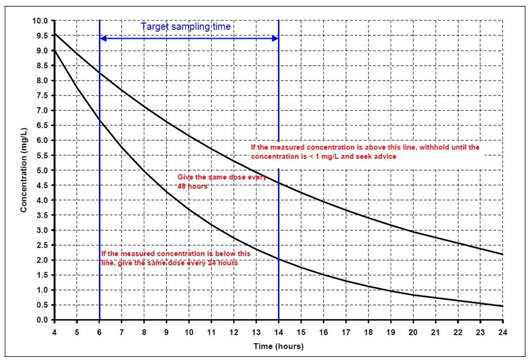
Check level as recommended (either at 6-14 hours or 24 hours post dose) and plot results on the chart to determine dose interval.

Monitoring levels and adjusting dosing interval

Check U+E daily. If serum creatinine changes significantly (e.g. > 15-20% change), clinicians may consider recalculating and adjusting dosing as per the calculator. 

  • This may be clinically relevant for patients with improving renal function (i.e. reduction in serum creatinine), for example due to AKI resolving, to prevent under-dosing.
  • For patients with worsening renal function (i.e. increase in serum creatinine), the gentamicin dose regimen should be guided mainly by the gentamicin levels and clinical picture. 

Check gentamicin concentration after each dose: 

Creatinine clearance (ml/min) When to check gentamicin concentration
>21 6-14 hours post dose
<21 24 hours post dose

Then check recommended dosing interval as per the chart below:

Gent monitoring graph

If the measured concentration is unexpectedly HIGH or LOW consider the following;

  • Were dose and sample times recorded accurately?  
  • Was the correct dose administered?  
  • Was the sample taken during drug administration?  
  • Was the sample taken from the line used to administer the drug?  
  • Has renal function declined or improved?  
  • Does the patient have oedema or ascites?

If in doubt take another sample 24 hours after the dose was given before re-prescribing and/or contact pharmacy for advice.

Editorial Information

Last reviewed: 01/06/2024

Next review date: 01/06/2027

Author(s): Scottish Antimicrobial Prescribing Group.

Version: 2.1

Approved By: Antimicrobial Management Committee